
How to Choose Flap Disc Shape
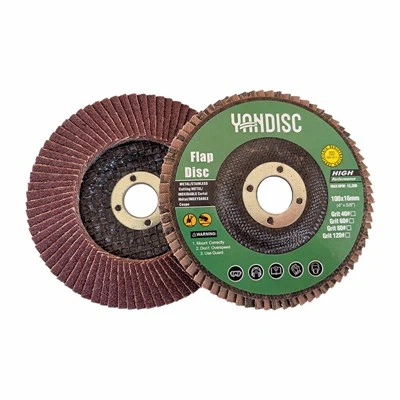
When discussing the shape of flap disks, we must firstly consider their structure and composition. Flap disc shape directly affects grinding angle, contact area and material removal rate.
Flap Disc Structure and Composition
Unlike standard grinding wheels, which consist of an even grinding surface made of abrasive grains bonded in place, abrasive flap disks consist of a ring of overlapping flaps. These flaps are loaded with coated abrasive grit-the same grit used in bonded abrasive cutting and grinding wheels-to grind and shape workpieces during fabrication, or to mix and finish welds.
Cutting and grinding discs usually have a fiberglass construction, while in flap discs the particles are adhered to a backing usually made of cotton, polyester or a blend. The coated abrasive cloth is cut into individual flaps and layered radially on a backing plate to form the flap disc structure.Rigid back panel provides stability and support.
There are two most common types of flap discs: flat types and conical type
Flat Flap Disc (Type 27); Flat flap discs, also known as Type 27 flap disks, typically grind best at angles between 0 and 15 degrees. They're best for smoothing and blending on flat surfaces and can work with light contours.
Conical Flap Disc (Type 29): Conical flap disks, also known as Type 29 lobe discs, have a disc-shaped grinding surface instead of a straight one. They usually grind best at an angle between 15 and 25 degrees. They enable aggressive cutting by maximizing surface contact on flat surfaces.
In general, operators should choose conical flap disks for initial high-volume grinding, and flat flap disks for fine polishing.